
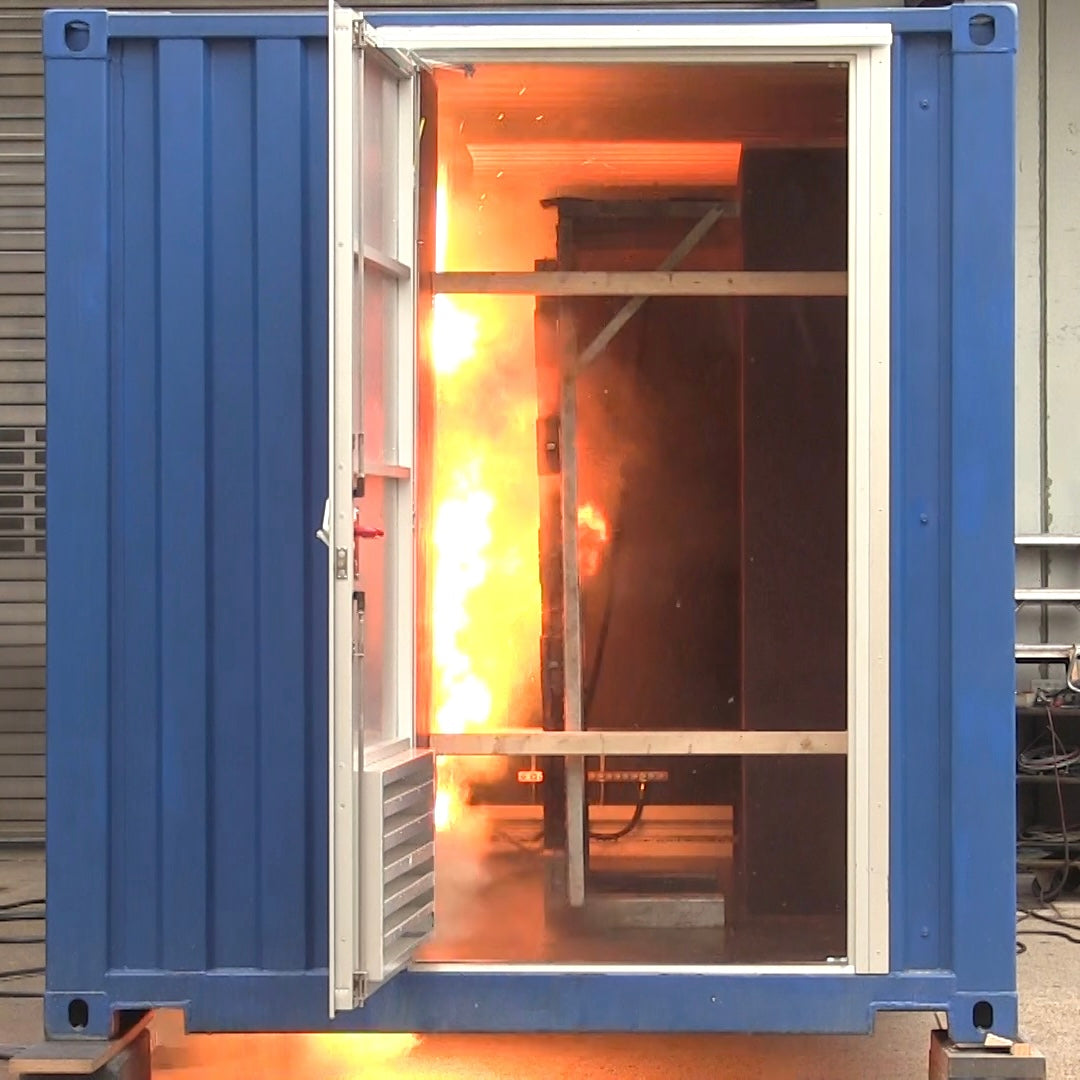
Modern medium-voltage systems form the backbone of numerous industrial companies, energy suppliers, data centers, charging parks, and infrastructure projects. While topics such as performance, efficiency, and power distribution often take center stage, a crucial aspect is frequently underestimated: arc fault safety.
An arc fault is one of the most dangerous fault events within electrical systems. Within milliseconds, temperatures can arise that significantly exceed the surface of the sun. At the same time, enormous pressure waves, metallic particles, and hot gases develop, which can cause significant damage and endanger human lives.
For manufacturers of container stations and operators of modern medium-voltage systems, the safe management of an arc fault has long ceased to be an optional safety feature; it is now a central component of modern energy infrastructure.
EnergieTechnik Becker GmbH developed the POWERBOXX® container station specifically for these challenges, relying on tested safety concepts, standard-compliant construction, and well-thought-out engineering.
What is an Arc Fault?
An arc fault is an uncontrolled electrical discharge within a system. It can be caused, for example, by technical defects, material failure, short circuits, operating errors, or external influences.
Unlike a normal short circuit, the energy is concentrated in an arc channel, which generates enormous thermal and mechanical stresses within a very short time.
Temperatures of up to 20,000 degrees Celsius can arise within just a few milliseconds. At the same time, a pressure wave forms and spreads through the system at high speed.
Additionally, the following are generated:
- hot gases
- vaporized metal particles
- intense light radiation
- mechanical stresses
- high pressure increases
This combination makes the arc fault one of the most critical risks in medium-voltage technology.
Why are Arc Faults so Dangerous?
The effects of an arc fault are often underestimated.
Many people initially think of an electrical short circuit. In reality, however, it is a complex fault event with significant dangers for people and systems.
Potential consequences include:
Danger to People
The temperatures generated can cause severe burns within a very short time. In addition, there are pressure waves, hot gases, and flying particles.
Danger to Systems
An arc fault can significantly damage or completely destroy switchgear, cable systems, transformers, and other components.
Danger to Operations
Even if no one is injured, production shutdowns, power outages, or long recovery times can cause significant economic damage.
Especially in industrial plants, data centers, or critical infrastructure, even a few minutes of downtime can cause high costs.
Why Container Stations Must Meet Special Requirements
Container stations combine medium-voltage technology, transformers, and other components in a comparatively compact space.
This creates special requirements for:
- space layout
- pressure relief
- ventilation
- mechanical stability
- personal protection
- escape routes
- safety concepts
While building-based stations sometimes have larger spaces available, container stations must meet all safety requirements within a compact design.
Precisely for this reason, the constructive management of potential arc fault events plays a central role in the development of modern container stations.
The Challenge: Controlling Pressure, Heat, and Gases
An arc fault not only generates extreme heat.
The rapid expansion of heated air and vaporized materials creates enormous pressure loads.
Without suitable protective measures, this can lead to:
- doors being forced open
- housing parts failing
- people being endangered
- adjacent system parts being damaged
A professional safety concept must therefore ensure that pressure and hot gases are discharged in a controlled manner.
This is precisely where modern engineering solutions differ from simple standard constructions.
The POWERBOXX® Safety Concept
The POWERBOXX® container station from EnergieTechnik Becker was specifically developed to control the effects of an arc fault.
The safety concept is based on several coordinated components:
Controlled Pressure Relief
Excess pressure generated is specifically directed to defined areas of the station.
Pressure Duct Systems
Specially developed pressure ducts ensure that pressure and hot gases can be discharged in a controlled manner.
Targeted Hot Gas Management
The gases generated are managed in such a way that risks to people and adjacent infrastructure are minimized.
Mechanically Robust Construction
The container structure is designed to withstand the resulting loads.
Functional Room Separation
Switchgear room and transformer room are constructively separated from each other and fulfill different safety-related tasks.
The interaction of these measures significantly reduces the risk to people and systems.
Why Room Layout is Crucial
A key component of the POWERBOXX® design is the clear separation of functional areas.
Switchgear Room
The switchgear room contains:
- medium-voltage switchgear
- protection technology
- measurement technology
- low-voltage distribution
This is where the control and protection of power distribution takes place.
Transformer Room
The transformer room houses the power transformer.
At the same time, it plays an important role in the safety concept as a defined pressure relief room.
In the event of a fault, pressure and hot gases can be controllably directed into this area and then discharged to the outside via appropriate systems.
This construction contributes significantly to the overall safety of the system.
Which Standards Apply to Arc Fault Safety?
In the field of modern container stations, the following standards are particularly important:
IEC 62271-200
This standard describes requirements for metal-enclosed AC switchgear in the medium-voltage range.
IEC 62271-202
This standard covers compact secondary substations and container stations.
It defines requirements for design, testing, and safety.
For operators and planners, these standards ensure that the systems have been developed and tested according to recognized technical standards.
What Does IAC-AB 20 kA / 1 s Mean?
When evaluating arc fault safety, the classification:
IAC-AB 20 kA / 1 s
often appears.
This designation describes the ability of a system to safely control an internal arc fault.
The classification means, simplified:
- 20 kA short-circuit current
- duration of one second
- protection for people inside the station
- protection for people outside the station
For operators, this means a high level of proven safety.
Independent Tests Build Trust
Safety concepts are only meaningful if they are tested under real conditions.
That is why the POWERBOXX® container station was tested in independent high-power test laboratories.
The facilities involved include:
- IPH Institut Prüffeld für elektrische Hochleistungstechnik Berlin (IPH Testing Laboratory for High-Power Electrical Engineering Berlin)
- Testing Laboratory Medium Voltage Frankfurt am Main
The successfully passed tests confirm the effectiveness of the safety concept and the standard-compliant design of the station.
Why Arc Fault Safety is Economically Important
In addition to personal safety, the economic aspect also plays an important role.
A serious fault event can cause significant costs:
- production losses
- repair costs
- replacement investments
- insurance claims
- business interruptions
A well-thought-out safety concept reduces these risks and helps to increase the long-term availability of the system.
Therefore, many operators now consider arc fault safety an important part of their investment decision.
For Which Projects is Arc Fault Safety Particularly Important?
This topic is particularly relevant for:
- industrial plants
- chemical plants
- data centers
- energy suppliers
- charging parks
- infrastructure projects
- critical infrastructure
- grid connection points
- wind farms
- photovoltaic systems
Wherever high power is transmitted and supply security is crucial, the safe management of potential fault events plays a central role.
Why EnergieTechnik Becker Relies on Tested Safety
EnergieTechnik Becker GmbH considers safety not an add-on function, but an integral part of modern medium-voltage technology.
Therefore, every POWERBOXX® container station is developed based on an integrated engineering process that considers electrical, mechanical, and safety requirements together.
The result is solutions that are not only technically powerful but also meet the highest requirements for personal and plant protection.
Conclusion: Arc Fault Safety is Not a Detail, but a Core Requirement
Anyone planning a container station today should consider arc fault safety early on. It not only determines the safety of operating personnel and maintenance technicians but also the long-term availability and economic efficiency of the entire system.
With the POWERBOXX®, EnergieTechnik Becker develops container stations that combine state-of-the-art medium-voltage technology with tested safety concepts. Thanks to controlled pressure relief, intelligent pressure duct systems, robust construction, and successful type testing, a solution is created that offers a high degree of safety even under extreme conditions.
For operators, this means trust, operational safety, and an energy infrastructure designed for the challenges of the future.
In our download area, you will find further brochures on arc fault testing as well as generally on our container stations: https://etb-karlsruhe.de/pages/fachbroschuren-energietechnik-becker-gmbh