
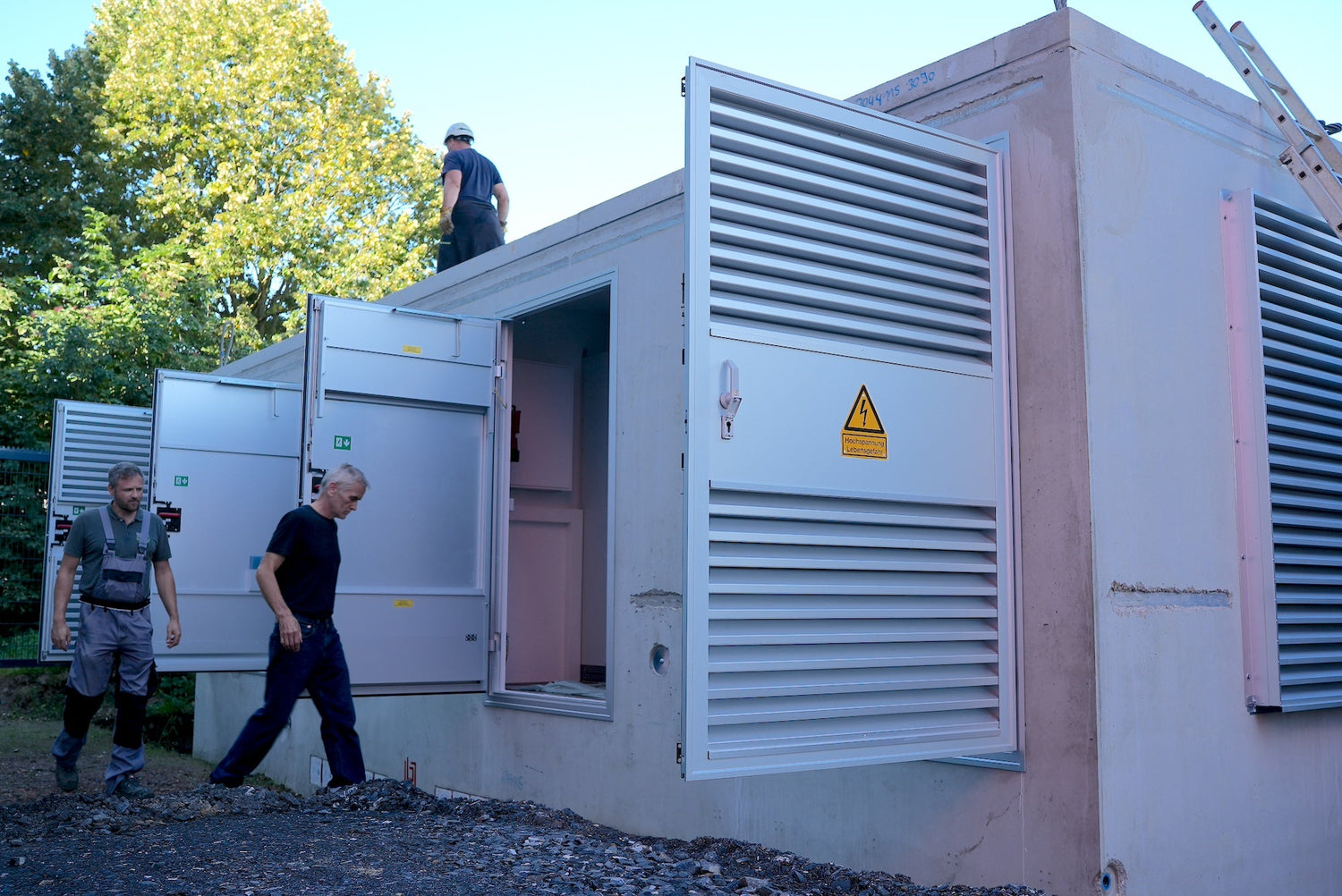
Transformer substations are the invisible backbone of many power supply networks. They operate in the background but are indispensable for grid stability, supply security, and the smooth operation of industry, commerce, critical infrastructures, and residential complexes. However, precisely because they mostly operate in the background, the need for regular maintenance and inspection is often underestimated – sometimes with serious consequences.
In this article, we show why professional maintenance of your transformer substation is not only legally required but also a decisive success factor for operational safety, economic efficiency, and legal certainty.
Why Transformer Substations Must Be Regularly Maintained!
Electrical systems are subject to numerous stresses during operation. In transformer substations, several risk factors combine:
- Dust, moisture, and corrosion attack components
- Mechanical influences such as vibrations or damage by third parties
- Faulty commissioning or overloading
- Rodents, plant growth, or insufficient ventilation
- Electromagnetic disturbances and voltage peaks
All these factors can impair the function of the transformer substation – often unnoticed. The consequence: increased risk of failure, shortened component lifespan, safety defects, and in the worst case, fires or grid disturbances.
Clear Advantages through Preventive Maintenance
Those who regularly inspect and maintain benefit in several ways:
- Safety Assurance: Defective components are identified and replaced in good time before hazards arise.
- Failure Protection: Disturbances are detected early, avoiding power outages.
- Extended Lifespan: Well-maintained stations last significantly longer and operate more efficiently.
- Legal Certainty: As an operator, you are obliged to inspect – for example, according to DIN VDE 0105-100, DGUV Regulation 3, and BetrSichV.
- Insurance Coverage: Without documented maintenance, there is a risk of losing claims in the event of damage.
- Economic Efficiency: You avoid unnecessary emergency deployments and preserve the value of your system.
- Legal Basis: Your Responsibility as an Operator
The most important regulations you should know as an operator of a transformer substation:
- DIN VDE 0105-100: Operation of electrical installations – regulates, among other things, inspection and maintenance intervals.
- BetrSichV: Obliges companies to safely provide and inspect electrical equipment.
- DGUV Regulation 3: Accident prevention regulation – requires regular inspection by qualified electricians.
- EnWG §49: Network operators must ensure operational safety according to the state of the art.
- Insurance Clause SK3602 (VdS): Without regular maintenance, insurance coverage may be lost.
Maintenance Creates Transparency and Predictability
A major advantage of professional maintenance is seamless documentation:
- Maintenance logs show the condition of the system over years
- Trend analyses support you in investment decisions
- Legal certainty vis-à-vis inspection authorities, insurers, and auditors
- Traceability in case of personnel or service provider changes
- Who is allowed to maintain and inspect?
Maintenance may only be carried out by qualified electricians. They must be specially trained and familiar with current standards. The 5 safety rules according to DIN VDE 0105-100 must be strictly observed. For operators, this means: Only use authorized, competent service providers – anything else can become expensive in the event of damage.
Conclusion: Those who maintain save risks and costs
The maintenance of transformer substations is not an option but an obligation – technically, legally, and economically. With a structured maintenance concept from ETB, you create transparency, security, and long-term reliability. Talk to us about your system – we help you minimize risks, comply with regulations, and operate your infrastructure in a future-proof manner.