
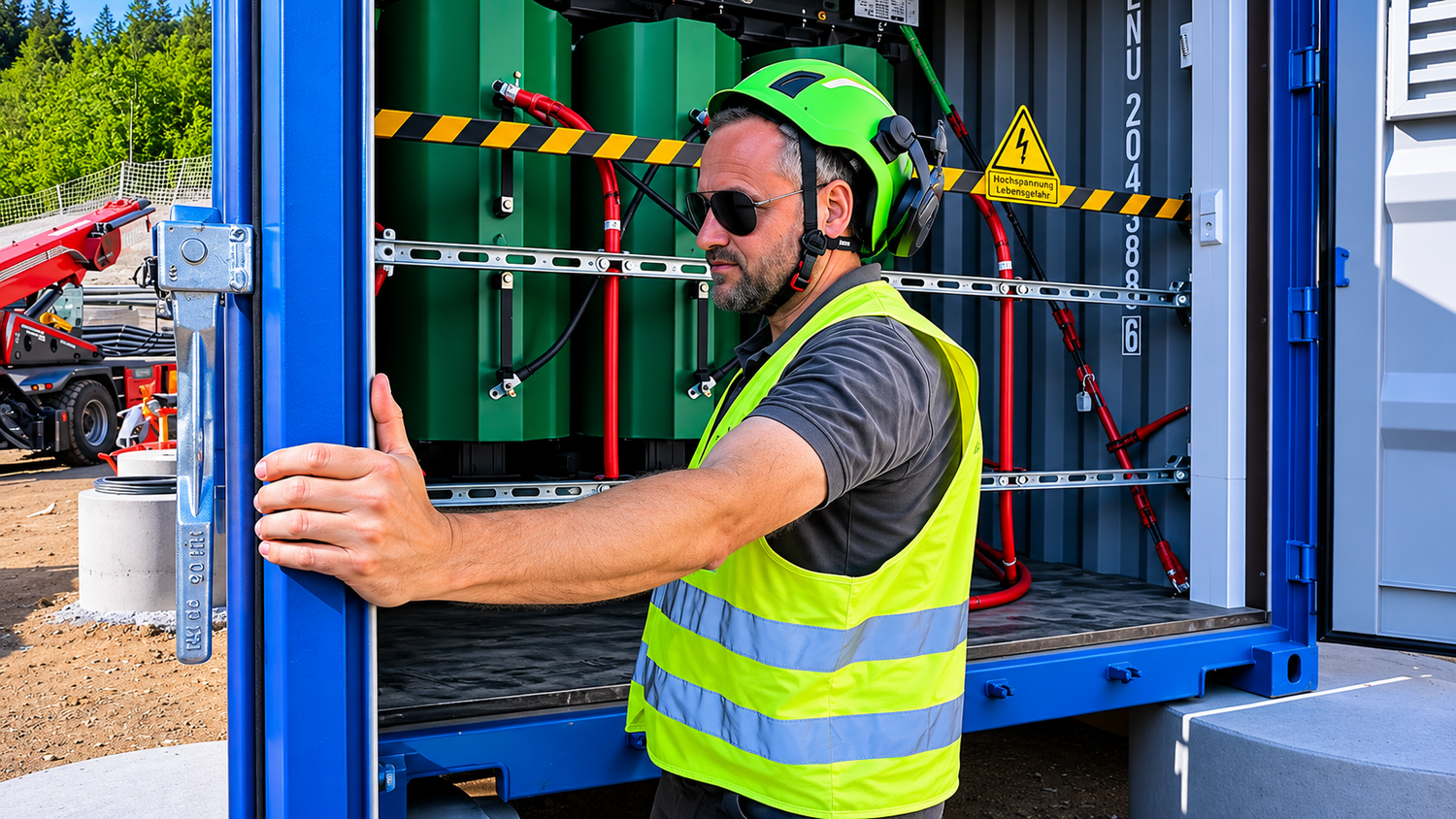
Electricity is indispensable, but also one of the greatest dangers on construction sites
Nothing works on modern construction sites without electricity. Cranes, machinery, container facilities, pumping systems, and lighting require a reliable power supply. At the same time, electrical energy is one of the greatest sources of danger on construction sites.
Defective systems, faulty installations, or inadequately secured power distribution can have serious consequences, from property damage and production losses to life-threatening accidents.
Therefore, compliant construction site power stations are far more than a technical necessity. They make a decisive contribution to protecting people, facilities, and projects.
But why are standards so important? What risks exist on construction sites? And how do modern construction site power stations contribute to safety?
Why construction sites place special demands on power supply
Construction sites are among the most demanding operating environments for electrical systems.
Typical challenges include:
-
changing operating conditions
-
weather influences
-
humidity
-
dust exposure
-
mechanical stress
-
frequent modifications
-
changing consumers
At the same time, many people from various trades work closely together in a confined space.
Even small errors can therefore have significant consequences.
What dangers arise from unsafe construction site power systems?
The risks are often underestimated.
The most common dangers include:
Electric shocks
Damaged cables, faulty connections, or defective protection systems can cause life-threatening electrical accidents.
Short circuits
Faulty installations or overloads can trigger short circuits and lead to considerable damage to machines and systems.
Fires
Electrical faults are among the most common causes of fires on construction sites.
Outages and downtimes
If the power supply fails, the entire construction site often comes to a standstill.
The consequences:
-
project delays
-
contract penalties
-
additional costs
-
production losses
Why standards are indispensable on construction sites
Standards and regulations were not developed to complicate projects.
Their goal is to protect people and minimize risks.
Compliant construction site power stations ensure that:
-
electrical systems can be operated safely
-
dangers are detected early
-
faults are automatically shut down
-
maintenance work can be carried out safely
This significantly reduces the likelihood of serious accidents.
What regulations apply to construction site power stations?
Numerous regulations must be observed during planning, installation, and operation.
The most important ones include:
DGUV Regulation 3
DGUV Regulation 3 governs the inspection of electrical systems and equipment.
It obliges operators to have electrical systems inspected regularly.
DIN-VDE standards
The DIN-VDE guidelines define the technical requirements for electrical systems and protective measures.
They form the basis for safe operation.
Occupational safety regulations
In addition, various occupational safety requirements must be met to protect employees from hazards.
Grid operator specifications
Depending on the connection type, additional technical requirements of the responsible grid operator apply.
What protection systems modern construction site power stations have
Modern construction site power stations have numerous safety mechanisms.
These include, among others:
Residual current devices (RCDs)
They detect dangerous fault currents and switch off the power supply within a very short time.
Short-circuit protection
Protection systems prevent damage from short circuits and limit potential effects.
Overload protection
Overloads are detected and the affected circuits are automatically switched off.
Contact protection
Dangerous live parts are protected against unintentional contact.
Weather protection
Housings and components are designed for use in harsh environmental conditions.
Why regular inspections can save lives
Even the best construction site power station must be checked regularly.
Daily use creates stresses that can lead to damage:
-
damaged cables
-
loose connections
-
wear and tear
-
moisture ingress
-
mechanical damage
Regular inspections help to detect and eliminate these risks early.
This prevents accidents before they occur.
Operators bear a high responsibility
Many responsible persons underestimate their own liability.
Anyone operating a construction site power system is responsible for:
-
employees
-
external companies
-
visitors
-
suppliers
-
public safety
If accidents occur due to defective systems, significant legal and financial consequences can arise.
These include:
-
claims for damages
-
fines
-
criminal consequences
-
reputational damage
A compliant construction site power station significantly reduces these risks.
Modern construction site power stations offer significantly more safety today
Technical developments have significantly improved the safety of electrical systems in recent years.
Modern construction site power stations often feature:
-
intelligent protection technology
-
energy monitoring
-
load management
-
remote monitoring
-
automatic fault reports
-
digital documentation
This allows problems to be detected and resolved early.
Why the manufacturer's quality is crucial
Safety begins with planning.
A compliant construction site power station does not arise by chance.
Required are:
-
technical expertise
-
standards competence
-
experience in power distribution
-
careful planning
-
high-quality components
-
comprehensive testing
The more complex a project becomes, the more important the manufacturer's experience becomes.
EnergieTechnik Becker develops safe construction site power solutions
EnergieTechnik Becker supports construction companies, industrial enterprises, and infrastructure operators in planning and implementing safe construction site power supply systems.
Our services include:
-
technical consulting
-
load analyses
-
engineering
-
planning of construction site power stations
-
standard-compliant design
-
commissioning
-
service and support
Operational safety, personal protection, and long-term reliability are always at the forefront.
Conclusion: Safety is not an extra, but a duty
Electrical energy is the basis of modern construction sites - at the same time, it harbors significant risks.
Compliant construction site power stations protect people, facilities, and projects from dangerous faults, failures, and accidents.
Those who rely on professional planning, high-quality components, and regular inspections create the conditions for safe and economical construction site operations.
Because in an emergency, a compliant construction site power station can protect far more than just technology; it can save human lives.