
Why Proper Power Planning Determines the Success of a Construction Project
Numerous processes run simultaneously on modern large construction sites today. Cranes move heavy loads, container systems supply construction site logistics, pumps operate continuously, and increasingly, charging infrastructures for electric vehicles or electric construction machinery are also being added.
The result: The energy demand on construction sites is continuously increasing.
Nevertheless, the required power for temporary construction power supply is often underestimated. The consequences range from recurring power outages and construction delays to significant additional costs.
But how much power does a large construction site actually need? Which factors must be taken into account? And why is professional planning of the construction power station so important?
Construction Power Supply Is Significantly More Complex Today Than Before
Just a few years ago, the construction power supply for many construction projects consisted of a few construction power distributors and a grid connection.
Today, the requirements are significantly higher.
Modern large construction sites need electricity for:
-
Tower cranes
-
Construction hoists
-
Concrete mixing plants
-
Container facilities
-
Heating and air conditioning systems
-
Dewatering and pumping systems
-
Construction site lighting
-
Tools and machinery
-
IT and communication systems
-
Charging infrastructure for electric vehicles
The larger the project, the more important professional power planning becomes.
Why the Connection Power is Often Misjudged
One of the most common causes of problems on construction sites is the incorrect estimation of actual power requirements.
Many plans are based exclusively on the rated power of individual consumers.
However, the crucial question is:
Which consumers run simultaneously and what peak loads occur?
Because these peak loads ultimately determine the necessary dimensioning of the temporary construction power station.
If they are not taken into account, the following threaten:
-
Overloads
-
Shutdowns
-
Voltage drops
-
Production interruptions
-
Delays in the construction process
Which Consumers Have the Greatest Impact on Power?
For large construction sites, the following consumers are particularly relevant:
Construction Cranes
Tower cranes are often among the largest individual consumers on a construction site.
Depending on the type and size, several dozen kilowatts of power may be required.
Construction Site Containers
Office containers, welfare containers, and common rooms require electricity for:
-
Lighting
-
Heating
-
Air conditioning
-
IT systems
-
Kitchen appliances
Especially in winter, energy demand increases significantly here.
Pumps and Dewatering
For civil engineering projects or tunnel construction sites, pumping systems often run around the clock.
This creates a continuous base load.
Concrete and Mixing Plants
Particularly for larger infrastructure measures, high peak loads arise here.
Charging Infrastructure
With the increasing electrification of vehicles and machinery, charging infrastructure is becoming an increasingly important factor in construction power planning.
Why Peak Loads Are More Decisive Than Average Values
A common misconception is to use average power consumption as the basis for planning.
In reality, the temporary construction power station must be designed for the highest simultaneous load.
An example:
Several cranes start simultaneously, while concrete pumps, container heaters, and charging facilities are also in operation.
In such moments, peak loads occur that can be significantly higher than average consumption.
A professional load analysis therefore considers:
-
Maximum power consumption
-
Simultaneity of consumers
-
Starting currents
-
Reserves for expansions
-
Future load developments
When Is a Transformer Station Necessary?
For smaller construction sites, a direct connection to the low-voltage grid is often sufficient.
For large projects, however, this solution often reaches its limits.
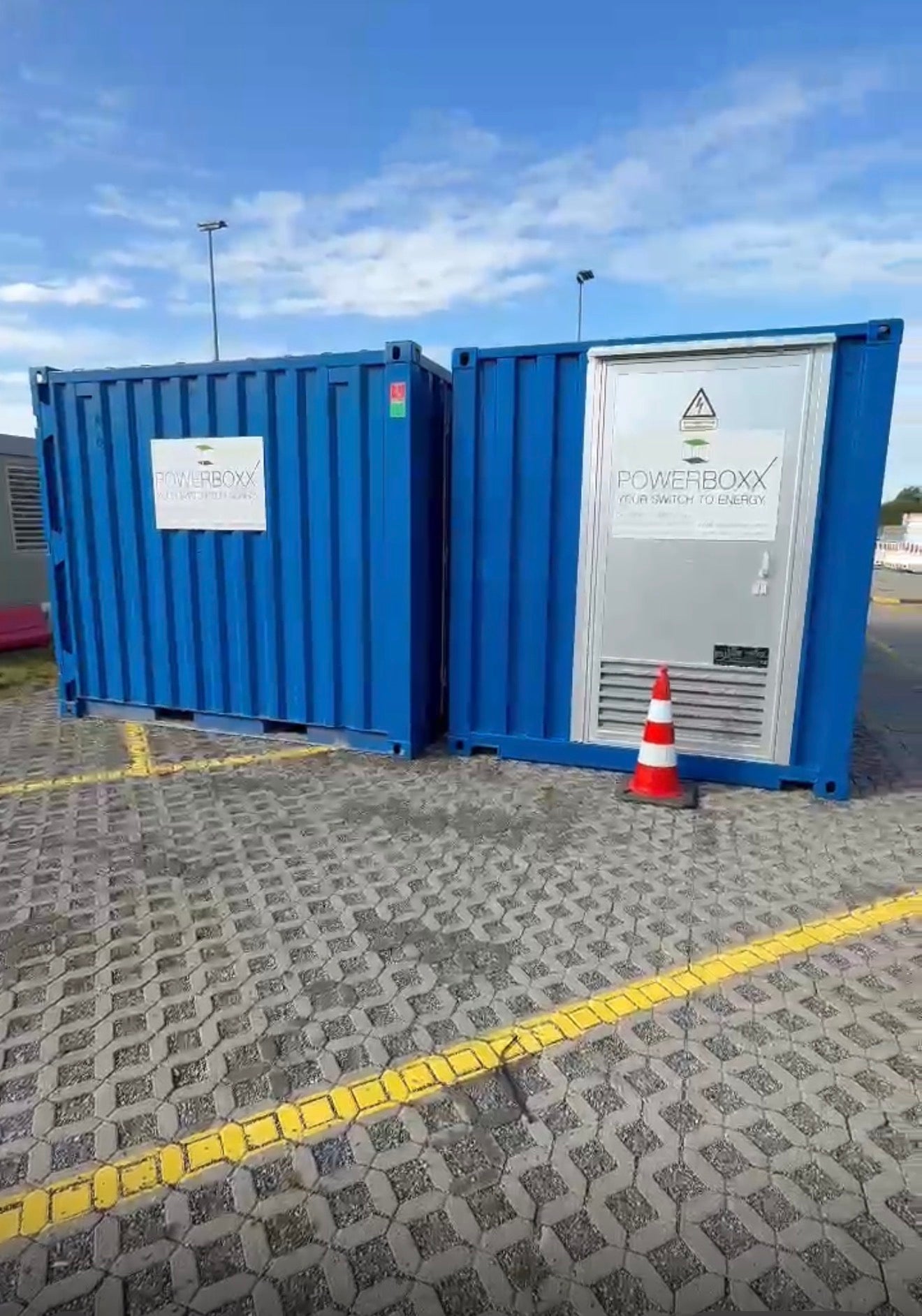
In such cases, temporary construction power stations with their own transformer technology are used.
They enable:
-
Higher capacities
-
Stable voltage supply
-
Greater supply security
-
Flexible energy distribution
-
Economical operation of large construction sites
Infrastructure and industrial projects, in particular, therefore often rely on individually planned transformer or container stations.
What Power Does a Typical Large Construction Site Need?
There is no general answer.
The actual power requirement always depends on the specific project.
Typical influencing factors are:
-
Construction size
-
Number of cranes
-
Machinery fleet
-
Container facilities
-
Project duration
-
Shift operation
-
Charging infrastructure
-
Future expansions
Therefore, dimensioning should never be based on estimates.
Every construction site requires individual consideration.
Why a Professional Load Analysis Is Indispensable
The basis of every reliable temporary construction power supply is a thorough load analysis.
All consumers are systematically recorded and evaluated.
The goal is to:
-
Correctly determine the necessary power
-
Plan for reserves
-
Consider future expansions
-
Avoid unnecessary investments
-
Develop an economical solution
A professionally planned temporary construction power station is often more cost-effective than an oversized standard solution.
Modern Temporary Construction Power Stations Offer Much More Than Just Electricity
The demands on construction sites are constantly evolving.
Modern temporary construction power stations often take on additional tasks today:
-
Load management
-
Energy monitoring
-
Consumption analysis
-
Remote access
-
Backup power supply
-
Integration of renewable energies
-
Charging infrastructure
This makes them a central component of modern construction site logistics.
Why the Manufacturer's Experience Is Crucial
Planning a temporary construction power station requires extensive knowledge in the areas of:
-
Energy distribution
-
Transformer technology
-
Protection technology
-
Grid connection planning
-
Load calculation
-
Safety concepts
Experienced manufacturers consider not only individual components but the entire energy infrastructure of the project.
This results in solutions that are safe, economical, and future-proof in the long term.
EnergieTechnik Becker Develops Individual Construction Power Solutions
EnergieTechnik Becker supports construction companies, industrial companies, and infrastructure operators in the planning and implementation of high-performance temporary construction power supply systems.
Our services include:
-
Load analyses
-
Technical consulting
-
Engineering
-
Planning of temporary construction power stations
-
Transformer stations
-
Container solutions
-
Commissioning
-
Service and support
We do not develop standard solutions but systems tailored individually to the project.
Conclusion: The Right Power Determines Project Success
A large construction site needs significantly more than just a power connection.
Underestimating the required power risks failures, delays, and unnecessary costs.
The basis of every successful temporary construction power supply is therefore a professional load analysis and an individually planned temporary construction power station.
With a well-thought-out energy supply, companies create the conditions for smooth construction processes, high operational safety, and maximum economic efficiency.